
DMA cheats for Escape From Tarkov — software, firmware and the kit

A DMA cheat pulls raid memory straight off a card instead of running as a program inside the Windows where the game lives. Nothing lands on the gaming PC — no process, no driver — so BattlEye has nothing to scan for. Everything renders on a second screen: radar with players, loot highlights, extract status.

This page covers what an EFT setup actually needs — a GhostWare subscription, firmware matched to your specific card, and a breakdown of the kit so you don't overpay for hardware you won't use.

Never built a DMA chain before? Start with the "What a DMA setup is made of" block

Software for EFT
Firmware and hardware

What a DMA cheat is and how it works in Tarkov

DMA stands for direct memory access. The card sits in a PCIe slot of a second computer, runs a cable to the gaming one, and reads its RAM past the CPU and past the operating system. The gaming PC never learns about it: as far as it can tell, there is a generic controller in the slot, the kind every motherboard already has several of.

All the math happens on the second box. That is also where the software runs, decoding raid coordinates and drawing them on its own screen. A classic internal cheat has to inject into the game process and leaves traces in memory. Here there is nothing to trace, because nothing was ever launched next to the game.

That is also the main limitation of the scheme: on its own it cannot press anything. To make aim move the mouse, you add a separate piece of hardware — a Makcu or a KMBox — which Tarkov sees as a plain USB mouse. Without it, DMA stays a radar and a set of highlights, which for a lot of players is exactly the point.
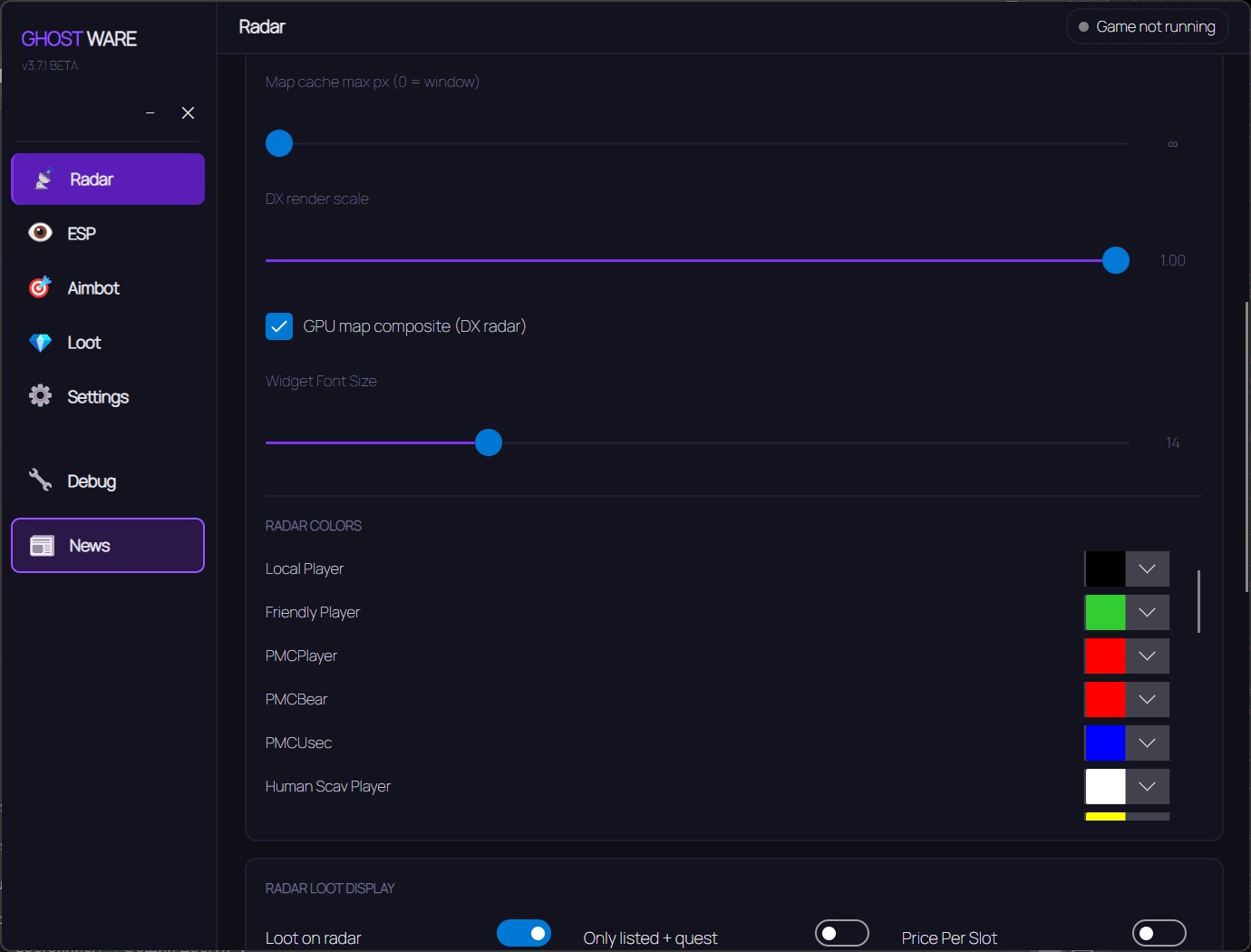
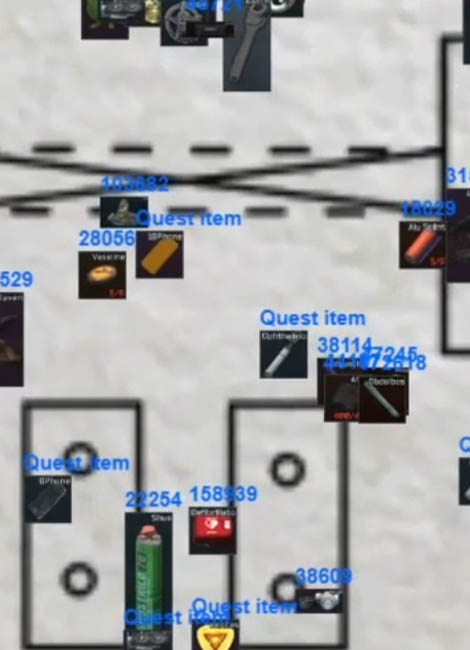
Our DMA software and services for EFT

What a DMA setup for EFT is made of

The build order is almost always the same, and most support tickets come from people who bought the card first and found out about the rest afterwards.

It starts with the second computer. Any office box or mini PC will do as long as it has a free PCIe slot. Nobody plays raids on it — its job is to crunch the data and draw the radar. That is where the card goes: a Captain DMA 75T at 8,450 RUB covers Tarkov with room to spare, and the version with a heatsink and thermal pad costs 11,500 RUB, which is what long-session players tend to pick.

Firmware comes next. It is a separate service and you cannot skip it: out of the box the card announces itself with factory identifiers. It gets matched to your card revision and to the anti-cheat of the game you play.

Two optional pieces come last. A Makcu at 2,300 RUB or a KMBox is needed for aim only — radar and highlights don't touch it. A Dichen V6 fuser at 8,999 RUB merges the video of both machines into one monitor, and without it you simply keep a second screen on the desk.

If you'd rather not deal with parts at all, prebuilt kits exist: 20,000 RUB without the second PC, 40,000 RUB with a mini PC inside. All of that is arranged on the firmware and hardware page.

Which DMA card to get for Tarkov: 35T, 75T or 100T

The number in the name is the amount of logic on the chip, and in practice it translates into memory read speed. Tarkov is fussier here than shooters with small maps: a raid on Customs or Streets holds hundreds of loot objects, bots and PMCs at once, and all of it has to be re-read several times per second.

The older 35T is bought to save money. It will carry a radar and player highlights, but on Streets of Tarkov the picture starts lagging behind the raid, and you end up looking at something that was true a moment ago.

The 75T is where most people sit, and it is what most firmware is written for. The speed headroom is wide enough that you stop thinking about this parameter at all.

A 100T is worth considering when the setup is meant for more than Tarkov. One catch: no public firmware exists for it, so the only route is a custom job.

Input: Makcu, KMBox and what a fuser is for

The card only reads. For the crosshair to swing onto a PMC behind a fence, something has to physically move the mouse, and that job goes to a small microcontroller. The software calculates the correction, sends it over a COM port, and the device reports itself as a regular mouse.

A Makcu is cheaper and covers most cases. The KMBox Net runs over a network connection, costs more, and is usually bought by people who already hit the limits of the first option. In an actual Tarkov raid the difference is barely noticeable — fights here are rarely won on reaction speed, it matters far more that you see who is pushing from where.

A fuser solves a different problem: the picture. Without one you keep two monitors on the desk, raid on the left, radar on the right. A fuser merges both signals into a single screen, and from the outside it looks like an ordinary game in a window.

Firmware for BattlEye: which level Tarkov needs

A card ships from the factory with its own identifiers, and in that state it looks like exactly what it is. Firmware rewrites that data so the device reads as a harmless controller, tuned to a specific revision, a specific motherboard and a specific anti-cheat.

Tarkov is covered by the entry level at 5,000 RUB, which handles BattlEye on both AMD and Intel. The pricier levels exist for people who also play EAC, ACE or Vanguard titles — that is where the 13,500 and 17,500 RUB tiers with a wider anti-cheat matrix come in.

There is no universal file that fits every card, and this is the classic beginner mistake: firmware pulled off a forum either refuses to flash, or flashes and leaves the card more visible than it was before. What we ask before matching one, and how the setup goes, is written out on the firmware page.

Can BattlEye detect a DMA card

Honest answer: an anti-cheat can read the presence of a device in a slot, because its driver sees the PCIe list the same way Device Manager does. The question is what it finds there — a factory card with obvious identifiers, or an unremarkable controller.

That shapes the practice. A stock card with no firmware is the fastest way to eat a ban. A card flashed for your specific build causes no trouble: to the system it is one more piece of hardware among dozens. While you are in there, check Kernel DMA Protection and IOMMU in the BIOS — with kernel protection enabled the chain simply won't come up.

What's left is the human factor, and it is the big one. Tarkov bans mostly follow reports and statistics: a hundred headshots in a raid and a loot run drawn in a straight line across the map raise questions with no anti-cheat involved at all. DMA gives you information, not immunity — how this looks from the ban team's side is covered in our article on ban waves.

DMA radar or a normal internal cheat

Internal builds are cheaper and start in five minutes: download the loader, enter the key, drop into a raid. No second PC, no cables. You pay for that by having the software live in the same system as the game, where there is at least something to look for.

DMA costs more up front and demands some fiddling with hardware, but after that the only recurring expense is the subscription. Another upside that rarely gets mentioned: the chain survives a Windows reinstall, and it moves with you to another game — only the software changes.

The choice usually comes down to your horizon. If you want to try a cheat for a wipe or two, an ordinary ESP build or a software radar makes more sense. If you are in Tarkov for the long haul and tired of rebuilding your system after every ban wave, DMA pays for itself.

What a Tarkov DMA setup costs

Counting the bare minimum, from scratch, without a prebuilt kit:

  • 75T card — 8,450 RUB
  • BattlEye firmware — 5,000 RUB
  • Makcu for aim — 2,300 RUB, skip this line if you only want radar
  • GhostWare subscription — from 180 RUB a day, 2,300 RUB a month
  • Second PC — whatever is already gathering dust at home, or a mini PC inside a prebuilt kit

That lands around 16,000 RUB to get in, and only the subscription after that. A prebuilt kit without the second PC is 20,000 RUB, with a mini PC 40,000 RUB. More than a one-off internal cheat purchase, but the hardware stays yours and doesn't evaporate with the next game update.

How to buy and what arrives after payment

The software is bought like any other item in the catalog: pick a term on the GhostWare page, pay through the oplata.info escrow, and the key with instructions arrives by email. The money sits with the escrow for 20 days, so if nothing launches you can claim it back.

Hardware and firmware are a separate conversation, because both are matched to your motherboard and CPU. Message support, tell them what you already own, and you'll get a list of what is still missing. If you have no card at all yet, say so — we'll put together an option that fits the budget.

Not what you were looking for?

Safe Deal

Buy a dma cheat for tarkov with escrow

Deals go through Oplata.info — an escrow service backed by Webmoney. Funds are frozen for 20 days, and if something goes wrong you can file a claim and get your money back.

  • The product arrives by email after payment
  • Chat with the seller on the payment page
  • Seller contacts in social networks and messengers
  • Financial claims (every seller is passport-verified)

We only work with proven partners — every seller has been in the Webmoney system for more than 3 years.

About the project and who created it

Frequently asked questions

Can I run a DMA cheat on a single PC?

No. The card sits in a second machine and reads the first one's memory over a cable. One computer cannot do this — you need at least a cheap second box or a mini PC.

Can BattlEye see a DMA card in Tarkov?

An anti-cheat driver can enumerate PCIe devices, which is exactly why the card is reflashed to look like an ordinary controller. What actually gets people caught is a bad DNA ID, stock firmware straight out of the box, and obvious behaviour in raid.

Which DMA card do I need for Escape From Tarkov?

The 75T is the working standard for EFT. The older 35T still handles radar and player ESP but runs out of read speed on the big maps. A 100T only makes sense if the setup is meant for several games.

Do I need a KMBox if I only want radar?

No. Radar and ESP just render on the second screen. A KMBox or Makcu is only required for aim, because something has to physically move the mouse.

What does a Tarkov DMA setup cost from scratch?

A 75T card is 8,450 RUB, a Makcu is 2,300 RUB, BattlEye firmware starts at 5,000 RUB and the software subscription starts at 180 RUB per day. Any old office PC works as the second machine. A prebuilt kit without the second PC costs 20,000 RUB.

Does DMA survive Tarkov wipes and patches?

The software is updated for each new game build, usually on patch day. The card firmware stays untouched because it has nothing to do with the Tarkov version.

A spare account for cheated raids

So that a ban lands somewhere other than the profile holding your stash and your played wipes, raids with software are run on a separate account. Steam accounts sorted by Tarkov edition start at 250 RUB: level one character, edition preserved, key delivered right after payment.

NFA Tarkov accounts →